ISSR CLASSES
Checkpoint Science
iGCSE Chemistry
iGCSE Physics
iGCSE Coordinated Science
A-Level Chemistry
PRACTICALS
Practicals Home
Practicals A-Z
Study Plan for Practical Work
|
A buffer solution is one which resists change in pH on addition of small amounts of acid or alkali. Be careful here - our "A" level biologists are often told that a buffer solution is one of constant pH. This is not true! There is always a change in pH on the addition of acid or alkali to a solution (unless they have the same pH!), but with a buffer, the change in pH is much less than that of an unbuffered solution. On the addition of a large amount of acid or alkali to a buffer, it becomes exhausted, and then the pH changes significantly. |
|
A buffer solution is made up of a weak acid and its salt, or a weak alkali and its salt. The two most commonly encountered buffers are ethanoic acid/sodium ethanoate and ammonia/ammonium chloride. We use Le Chatelier's principle to explain their action. We can illustrate this using the ethanoic acid/sodium ethanoate example:
|
1.
CH3COOH(aq) |
|
2. H2O(l) |
Equilibrium (2) is established in all aqueous systems. Equilibrium (1) applies to this particular buffer. There is a lot of CH3COOH(aq) from the added ethanoic acid and a lot of CH3COO-(aq) from the added sodium ethanoate.
If some acid (H+(aq)) is added to this buffer, equilibrium (1) shifts to the left removing some of the added acid by Le Chatelier's principle. This limits the change in pH.
If some alkali (OH-(aq)) is added to this buffer, equilibrium (2) shifts to the left to remove some of the added OH-(aq). In so doing, it also removes some H+, and without the buffer this would lead to a significant increase in the pH. However, when the H+ concentration decreases, equilibrium (1) shifts to the right by Le Chatelier's principle making more H+. This replaces some of the removed H+ ions, so reducing the decrease in hydrogen ion concentration, and so limiting the change in pH.
In simpler terms, added alkali reacts with (and is "soaked up" by) the acid in the buffer. Added acid reacts with the acid salt in the buffer. This will continue until either of the buffer components is used up. At this point the buffer can no limit the pH change and there is a rapid rise or fall in pH. The buffer is said to be exhausted.
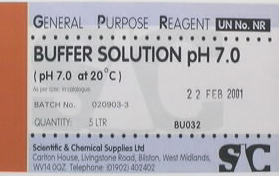
Buffer solutions are used extensively in biochemistry and also in the setting up of a pH meter.
A buffer will be created if a weak acid is partly neutralized by a strong base (some of the acid is converted into the salt) or a weak base is part neutralized by a strong acid.
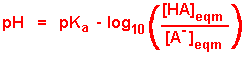
It is very useful to be able to calculate the pH of a buffer or to be able to work out the quantities of weak acid and salt required to make a buffer of a particular pH. To do this we need to use a rearrangement of the Ka expression. This can be learnt or worked out. If you prefer to work things out, you can find out how here .
|
|
where pKa = - log10Ka. If you make [HA] and [A-] equal then pH = pKa.
Students can find these calculations quite difficult, so don't be too worried if they take a bit of working out!
Example 1
2.5 grams of sodium ethanoate was added to 100 cm3 of 1.0 M ethanoic acid. What is the pH of the resulting buffer? Assume the addition of the solid has a negligible effect on the overall volume of the solution. Ethanoic acid Ka = 1.7 × 10⁻⁵ mol dm-3
[HA] = 1.0 M, Volume = 0.1 dm3
CH3COONa = 82
Number of moles of CH3COONa = 2.5/82 = 0.030 mol
[A-] = 0.030/0.1 = 0.30 M
pKa = -log10Ka = 4.8
pH = 4.8 - log10(1.0/0.30) = 4.8 - 0.52 = 4.3
Example 2
How would you make a pH 4.0 buffer from methanoic acid and sodium methanoate? Methanoic acid Ka = 1.6 × 10⁻⁴ mol dm-3
pKa = -log10Ka = 3.8
We need to rearrange the above equation:
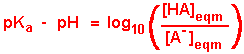
3.8 - 4.0 = - 0.2 = log10([HA]/[A-])
If we remove the log10, we shall get the ratio of acid (methanoic) concentration to anion (sodium methanoate) concentration.
We remove the log10 by performing an inverse log or 10x operation on both sides:
([HA]/[A-]) = 10-0.2 = 0.631
This is a question with a number of reasonable answers. What we have worked out is that if the ratio of methanoic acid to sodium methanoate is 0.63, then the buffer will have a pH of 4.0. It is up to us to choose how much acid or salt that we shall use. We can't use more than would be readily soluble in water. Neither would it be sensible to try to use very small values. Although the buffer might have the correct pH, there would be little material to react with any added acid or base, so the buffer would become quickly exhausted.
In this case I'll choose to make the methanoic acid 1.00 M, then the sodium methanoate concentration would have to be 1.00/0.631 = 1.58 M
HCOOH = 46, HCOONa = 68
So dissolve 46 g of methanoic acid and 1.58 × 68 = 108 g of sodium methanoate in a beaker and make up to exactly 1 dm3 in a volumetric flask.
You can get some further practice with exercise 1 and exercise 2.
 CH3COO