ISSR CLASSES
Checkpoint Science
iGCSE Chemistry
iGCSE Physics
iGCSE Coordinated Science
A-Level Chemistry
PRACTICALS
Practicals Home
Practicals A-Z
Study Plan for Practical Work
|
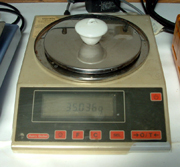
This is an experiment which involves the measuring of the mass of the chemicals involved. It can be used to work out the formula of a compound or the mass of a substance present in a mixture. I'll give an example of each of these problems. You need to be confident in using mole calculations. Strong heating is involved in many of these experiments, so care has to be taken to avoid burns. |
|
Determining the formula of magnesium oxide
|
|
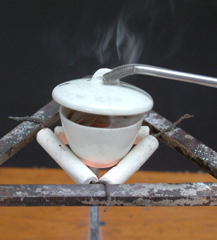
A piece of magnesium ribbon is cleaned with emery paper in order to remove any surface contamination. A crucible and lid is weighed. The cleaned magnesium is placed in the crucible and the lid is put on it. It is reweighed. The crucible is heated strongly and when the magnesium starts to burn in the air, the lid is lifted slightly to allow fresh air to get to the magnesium, whilst trying to limit the escape of the magnesium oxide smoke. When the reaction appears to be complete, the crucible is allowed to cool. When it is cold, the crucible, lid and magnesium oxide residue are weighed. Use the data below to work out the formula of magnesium oxide. |
Mass of crucible and lid = 35.037 g
Mass of crucible, lid and magnesium = 35.536 g
Mass of crucible, lid and magnesium oxide = 35.848 g
Mass of magnesium = 35.536 - 35.037 = 0.499 g
Mg = 24
\number of moles of magnesium = 0.499/24 = 0.0208
Mass of oxygen = 35.848 - 35.536 = 0.312 g
O = 16
\number of moles of oxygen = 0.312/16 = 0.0195
\ratio Mg:O = 0.0208/0.0195:1 = 1.07:1
The nearest simple number ratio is 1:1, so the formula is MgO
What errors have led to the 7% difference from the correct 1:1 ratio? Check your answer here.
Measuring the sulfate content of a water sample
100 cm3 of brewing liquor (water) from Burton-on-Trent is measured out accurately with a pipette. An excess of barium chloride solution is added so that barium sulfate precipitates:
|
Ba2+(aq) + SO42-(aq) ⇒ BaSO4(s) |
The precipitate is carefully filtered off using an ashless filter paper . The beaker is rinsed out several times to ensure that all the precipitate is collected. The filter paper is now put in a weighed crucible and placed in a high temperature laboratory furnace. This burns off the paper and dries the precipitate. Calculate the mass of sulfate in the water in parts per million (ppm).
Mass of crucible = 28.074 g
Mass of crucible and dry barium sulfate precipitate = 28.229 g
Mass of barium sulfate = 28.229 - 28.074 = 0.155 g
BaSO4 = 233
\number of moles of BaSO4 = 0.155/233 = 0.000665
\number of moles of SO42- = 0.000665
SO42- = 96
\mass of SO42- in 100 g of water = 0.000665 × 96 = 0.0639 g
\mass of SO42- in 1 g of water = 0.0639/100 = 0.000639 g
\mass of SO42- in 1000000 g of water = 0.000639 × 1000000 = 639 g
Answer = 639 ppm of sulfate
The accuracy of precipitation methods relies on the precipitate being completely insoluble. You can check how valid this is, in this case, by looking up the solubility of barium sulfate in a data book.
A watch glass was weighed and then a thin layer of hydrated copper(II) sulfate was carefully added. The watch glass and salt was now reweighed and placed in an oven at 250 ºC for two hours. The watch glass was then removed from the oven and allowed to cool in a desiccator before a final weighing.
Use the data below to calculate the number of moles of water of crystallization in the original salt. Suggest why the experiment might give an incorrect answer when the oven was set at 150 ºC and if the salt was heated very strongly in a crucible. Why was a watch glass chosen rather than a crucible? Why was around 8 grams of salt chosen? How could the experiment be improved?
Mass of watch glass = 25.233 g
Mass of watch glass and hydrated salt = 33.789 g
Mass of watch glass and salt after heating = 30.726 g