ISSR CLASSES
Checkpoint Science
iGCSE Chemistry
iGCSE Physics
iGCSE Coordinated Science
A-Level Chemistry
PRACTICALS
Practicals Home
Practicals A-Z
Study Plan for Practical Work
|
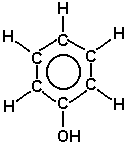
Phenols have a benzene ring to which an OH group is directly attached. They have some similarity to alcohols, but the closeness of the two groups affects both the benzene ring and the OH group. The simplest of the phenols is phenol itself. This used to be called carbolic acid and was the original antiseptic discovered by Lister. |
|
|
|
phenol |
A single OH group directly attached to the ring is named phenol. With additional ring substituents normally named as prefixes (at the start), we name in the same way as the arenes, with the OH group called phenol and assumed to be at position number 1. This can be seen in the first two examples below.
To complicate things, more than one OH group is named using the suffix -ol, in the same way as the alcohols. This can be seen in the third example.
Finally, if the other ring substituent is normally named at the end, the phenol is named with the prefix hydroxy-. This time we assume that the other substituent is at position number 1 and number the hydroxy- to show where it is compared to position number 1. The final example shows this type of naming.
Examples
|
|
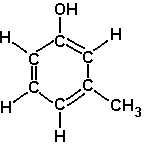
This phenol has a methyl group at position 3, so is called 3-methylphenol. |
|
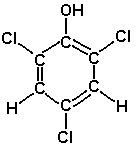
This phenol has three chlorine atom substituents. Taking the OH to be at position number 1, gives the name 2,4,6-trichlorophenol. It is better known by its initials, TCP - the antiseptic. |
|
|
|
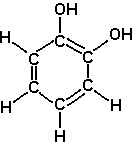
This third example shows a molecule with two phenolic functional groups. It is called benzene-1,2-diol (old name catechol). |
|
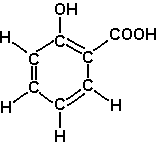
Here the carboxylic acid group is named at the end. This means that the phenol must be named at the start using hydroxy-. This is 2-hydroxybenzoic acid. This is commonly known as salicylic acid. It is found in willow bark and used in the manufacture of aspirin. |
|
You might expect that the reactions of phenol would resemble those of the arenes (as we have a benzene ring) and those of the alcohols (as we have an OH group). To a degree, this is the case, but the closeness of the two groups affects the properties of both.
|
|
The test for a phenol uses neutral iron(III) chloride solution. A positive test gives a violet colouration on addition to the phenol. |
Exercise
|
|
|
|
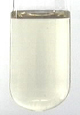
Phenol bottle and sample of phenol |
A closer look! |
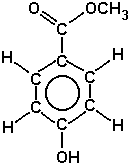
Phenols are compounds in which an OH group is directly attached to an arene ring. Phenol itself is a pale pink solid with very corrosive properties. Contact with the skin leads quickly to the formation of unpleasant blisters. Consequently, we shall be using a safer alternative called methyl 4-hydroxybenzoate:
|
|
|
|
phenol |
methyl 4-hydroxybenzoate |
Watch the videos in each of the following sections. Try to answer all of the questions and then check your conclusions about phenolic compounds using the links below.
1 Solubility in water
Phenol itself is only sparingly soluble in water. When added to water the solid forms as an oily liquid under the water. Try to think why this happens. You might like to look at the phenol label above.
Look at the structure of methyl 4-hydroxybenzoate and try to decide whether it will dissolve in hot and/or cold water:
Video - the solubility and pH of methyl 4-hydroxybenzoate in water
You will see from the pH of the resulting solution that this compound is very weakly acidic. Phenol itself is around pH 6 in solution. This is more acidic than neutral alcohols but much less acidic than the weak carboxylic acids. The reason for this can be found in the section on solubility and pH of phenol.
2 Phenolic compounds as acids
Video - action of sodium on phenols
What is the gas seen produced by this reaction? Which bond is broken in the phenolic compound? Try to write an equation for the reaction which takes place. You might like to remind yourself of the reactions with alcohols.
Video - action of sodium hydroxide solution on phenols
The phenolic compound is clearly much more soluble in sodium hydroxide solution than it was in water. Try to write an equation for the reaction which takes place and explain the much increased solubility. What is the explanation for your observation on adding concentrated hydrochloric acid to the newly formed solution?
Video - action of sodium carbonate on phenols
Did you notice any effervescence of carbon dioxide gas in this experiment? What does this tell you about the acidic strength of this phenolic compound?
3 Reaction with an organic acid
This is the same type of reaction as the formation of esters by this general reaction:
|
ACID + ALCOHOL |
Phenols are insufficiently reactive to react readily with an acid. However, they will react with the more reactive acid anhydrides, like ethanoic anhydride, as seen in the video. Try to write an equation for the reaction seen and suggest why phenols are less effective nucleophiles than alcohols.
Video - the formation of an ester
Theory - phenols in ester formation
4 Properties of the benzene ring
Apart from possessing a phenolic functional group, phenols also possess a benzene ring. In this section we investigate whether the presence of the phenolic group influences the properties of the benzene ring. You might like to review the arene practical.
Combustion
Video - combustion of a phenolic compound
Describe the type of flame that you see and explain it in terms of the molecular formula for the compound. We have used this type of argument before.
Reaction with bromine
Video - the reaction of methyl 4-hydroxybenzoate with bromine
With phenol an electrophilic substitution reaction occurs in which three atoms of bromine become attached to the ring producing a symmetrical compound. Try to write an equation for the reaction between phenol and bromine. Explain why there is a difference in the reactivity of the phenol towards bromine compared to that of the simple arenes. Suggest an equation for the reaction between methyl 4-hydroxybenzoate and bromine.
Reaction with nitric acid
Video - the reaction of nitric acid with methyl 4-hydroxybenzoate
In this reaction the addition of the nitro group reduces the reactivity of the ring so that only one substitution takes place. Try to write an equation for the reaction between phenol and nitric acid and explain how many isomers are possible. The same explanation as that with bromine should explain the difference in reactivity as compared to the reaction of a simple arene.
Theory - the properties of the phenolic benzene ring




 ESTER + WATER