ISSR CLASSES
Checkpoint Science
iGCSE Chemistry
iGCSE Physics
iGCSE Coordinated Science
A-Level Chemistry
PRACTICALS
Practicals Home
Practicals A-Z
Study Plan for Practical Work
|
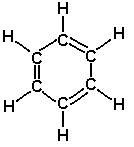
A molecule containing a benzene ring. The simplest arene is benzene itself. However, this is not allowed to be used in schools and colleges as it is thought to be carcinogenic . To understand the reactions of the arenes you need to appreciate the concept of delocalisation. The arenes are known as aromatic compounds, in contrast to the chain aliphatic compounds which we have met. |
|
|
Benzene |
|
|
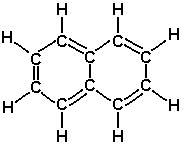
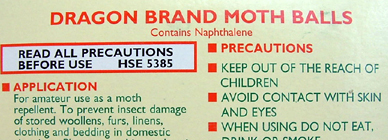
You should recognize benzene itself and you may meet the double fused ring naphthalene, C10H8. Naphthalene is used in moth balls.
|
|
naphthalene |
|
|
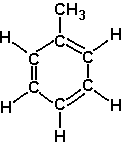
We shall meet a number of arenes with different side chains attached. Alkyl side chains are named with the prefix alkyl, giving a name of the type alkylbenzene. Methylbenzene is the most common of these, and has the old name of toluene. |
|
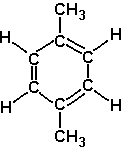
With more than one alkyl group attached we need to use numbers to show there relative positions. The molecule shown on the right is 1,4-dimethylbenzene. Always number in the direction that gives the smallest set of numbers. |
|
|
|
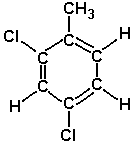
Attached halogens are given the usual chloro-, bromo- and iodo- prefixes. If an alkyl group or a functional group named with a suffix is already present on the ring, we assume that this is at position number 1. Hence, the molecule on the left is known as 2,4-dichloromethylbenzene. |
|
The NO2 group is given the prefix nitro-. The molecule shown is 2,4,6-trinitromethylbenzene. This was formerly known as trinitrotoluene - the high explosive TNT. |
|
|
|
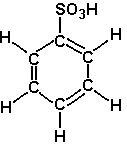
The sulphonic acids have the SO3H group. Sulphonic acids are used in the manufacture of soapless detergents. Benzene sulphonic acid is the simplest of this group. |
|
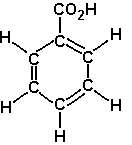
This is an aromatic carboxylic acid. It's systematic name is benzene carboxylic acid, but it is more commonly known as benzoic acid. |
|
|
|
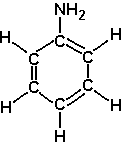
This is an aromatic amine named phenylamine (old name aniline). It is very important in the manufacture of dyes. It illustrates the use of the prefix phenyl-, which is the benzene ring missing one hydrogen atom, C6H5-. Students frequently confuse it with phenol. |
Although arenes can react by addition it is more common for substitution reactions to take place. You should understand the theory behind this.
You are generally expected to know the reactions of benzene itself, although you will not be carrying out any practical work with it.
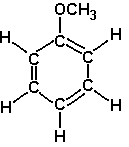
In this experiment we look at the typical reactions of arenes, and also investigate the effect that the side chain has on the reactivity of the ring. Look at the videos showing the experiments with methylbenzene. Make notes of any changes you see and check your observations using the theory link. Repeat this procedure for the reactions of methoxybenzene. In this case try to write equations for any of the reactions you see. You may want to check out the typical reactions of the benzene ring. Try to explain any difference in reactivity between the methylbenzene and methoxybenzene.
|
|
|
|
methylbenzene |
methoxybenzene |
Procedure for methylbenzene
1 Combustion
What type of flame does methylbenzene burn with, and what is it about the structure of the molecule that results in this flame type?
Video - combustion of methylbenzene
2 Oxidation
We use acidified potassium manganate(VII) solution in this experiment. Is there any sign of reaction and how does the reactivity compare to that of the alkenes?
Video - oxidation of methylbenzene
Video - oxidation of cyclohexene
3 Action of bromine
Look for signs of reaction in the video and contrast the reactivity with that of the alkenes.
Video - bromination of methylbenzene
Video - bromination of cyclohexene
4 Action of sulphuric acid
We use concentrated sulphuric acid in this experiment. Does this mix with the methylbenzene? Were there any signs of reaction? Again compare the reactivity to that of the alkenes.
Video - the reaction of methylbenzene and concentrated sulphuric acid
Video - the reaction of cyclohexene and concentrated sulphuric acid
Theory - the reactions of methylbenzene
Procedure for methoxybenzene
1 Bromination
How does the reactivity of methoxybenzene towards bromine compare with that of methylbenzene? Try to suggest why there is a difference. What are the fumes which are given off? Write an equation for the reaction assuming that only one mole of bromine reacts with one mole of methoxybenzene.
Video - the bromination of methoxybenzene
2 Sulphonation
Describe the changes seen in this reaction with concentrated sulphuric acid. Write an equation for the reaction assuming that one mole of sulphuric acid reacts with one mole of methoxybenzene.
Video - the sulphonation of methoxybenzene
3 The Friedel-Crafts reaction
This is a very important reaction in organic synthesis. The aluminium chloride is the catalyst, and care needs to be taken with it as it is a very reactive substance. You will see plenty of fumes given off, which you should be able to identify from the test shown. Again, try to write an equation for the reaction assuming a 1:1 reaction between the methylbenzene and the 2-chloro-2-methylpropane.
Video - the Friedel-Crafts reaction
4 Nitration
A mixture of concentrated nitric acid and water is used in this experiment. Make a note of any signs of reaction in this case and try to write down an equation for the reaction, again assuming a 1:1 reacting ratio.
Video - the nitration of methoxybenzene
Theory - the reactions of methoxybenzene