ISSR CLASSES
Checkpoint Science
iGCSE Chemistry
iGCSE Physics
iGCSE Coordinated Science
A-Level Chemistry
PRACTICALS
Practicals Home
Practicals A-Z
Study Plan for Practical Work
1 The silver halides
Silver chloride, silver bromide and silver iodide are insoluble in water so can be made by precipitation. This precipitation reaction is used as a test for halide ions.
2 The action of concentrated sulfuric acid on the potassium salts
The idea behind this sequence of reactions is that the hydrogen ions from the acid will meet up with the halide ions from the potassium salts to form hydrogen halides. This is exactly what happens with the potassium chloride:
|
H2SO4(aq) + KCl(s) ⇒ KHSO4(aq) + HCl(g) |
The similar reaction with sodium chloride is the standard method of preparation of hydrogen chloride gas.
When we try the same reaction with potassium bromide or potassium iodide we have only limited success. This is because concentrated sulfuric acid is a strong oxidizing agent. The hydrogen bromide and hydrogen iodide produced in these reactions are oxidized to bromine and iodine respectively. Watch the video which shows these reactions.
Video - the reactions of concentrated sulfuric acid with the solid halides
|
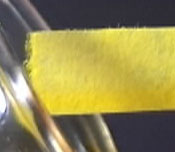
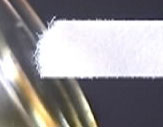
If the hydrogen halides are oxidized, then the sulfuric acid (sulfur oxidation state +6) must be reduced. We can detect sulfur dioxide (sulfur oxidation state +4) in both the bromide and iodide reactions. Even further reduction takes place with the iodide reaction and we can also detect hydrogen sulfide (sulfur oxidation state -2). This very poisonous gas smells of rotten eggs. We test for the sulfur dioxide gas using orange sodium dichromate paper. It turns green in the presence of sulfur dioxide. Lead ethanoate paper turns black in the presence of hydrogen sulfide gas. |
|
|
|
|
|
|
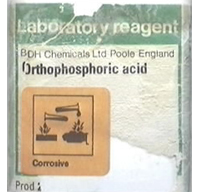
Because of the problem of oxidation with concentrated sulfuric acid we use concentrated phosphoric acid to produce samples of hydrogen bromide and hydrogen iodide gases. The phosphoric acid is still acidic enough to provide hydrogen ions to combine with the halide ions, but it is not a very strong oxidizing agent. Having said this, you will probably still see traces of iodine in the reaction between phosphoric acid and iodide. |
|
2NaBr(s) + H3PO4(aq) ⇒ Na2HPO4(aq) + 2HBr(g) |
3 The properties of the hydrogen halides
|
We have seen in part 2 that all the hydrogen halides can be prepared by the action of concentrated phosphoric acid on the corresponding solid halide. The hydrogen halides are all colourless gases which are extremely soluble in water. They are consequently collected by downward delivery. |
|
|
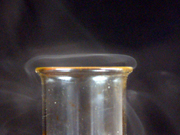
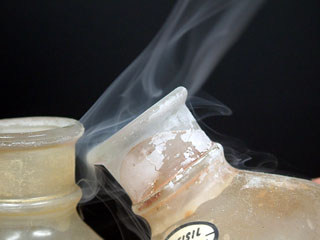
As the hydrogen halides are colourless gases you can't see them. However, because they are so soluble in water, they cause water vapour in the air to form fine droplets and so white misty fumes are often seen at the mouth of the test tube. |
|
The solubility of the gas in water
|
|
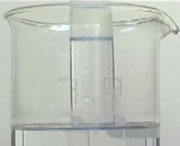
A striking demonstration of the solubility of the hydrogen halides in water is to invert a test tube of hydrogen halide gas into a beaker of water. The gas dissolves in the water and the water rises up the test tube to take the place of the dissolved gas: Video - the solubility of hydrogen halide gas in water Hydrogen chloride gas dissolves in water to form hydrochloric acid. Similarly, hydrogen bromide forms hydrobromic acid and hydrogen iodide forms hydroiodic acid. |
The reaction of the gas with ammonia gas
|
All the hydrogen halide gases react with ammonia gas in a very similar reaction. They all produce a white smoke of solid ammonium halide:
|
|
The stability of the gas towards heat
|
|
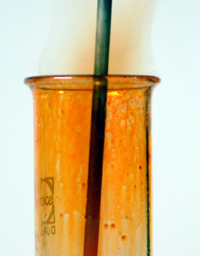
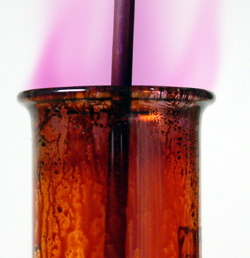
This is investigated by placing a red hot nichrome wire into a test tube of the hydrogen halide gas. We find no sign of reaction with the hydrogen chloride gas, but both the hydrogen bromide and hydrogen iodide break down into their elements:
In the first reaction we see brown bromine vapour and liquid. In the second reaction we see purple iodine vapour and solid iodine on the side of the test tube. The fact that the hydrogen iodide gas decomposes most readily into its elements suggests that the atoms were not so strongly attached in the first place. In technical terms, this means that the bond energy (the energy required to break a covalent bond) is lowest: |
|||
|
|
|
Bond |
Bond energy (kJ mol-1) |
|
|
H-Cl |
432 |
|
|
H-Br |
366 |
|
|
H-I |
298 |
The low bond energy is the result of the larger size of the iodine atom. Consequently, the bond pair of electrons is further away from the two nuclei it is holding together.