ISSR CLASSES
Checkpoint Science
iGCSE Chemistry
iGCSE Physics
iGCSE Coordinated Science
A-Level Chemistry
PRACTICALS
Practicals Home
Practicals A-Z
Study Plan for Practical Work
We can test for individual ions using ion-selective electrodes connected to a meter. These use an electrical method to determine the concentration of a specific ion. However, these devices are not common in the "A" Level laboratory. Cations (positive ions) can be identified by flame tests. It's also worth checking the tests for gases. A number of simple chemical tests used to identify different inorganic substances follow:
Warming with dilute sodium hydroxide solution releases ammonia gas. This is an alkaline gas so turns damp red litmus paper blue. It also has a characteristic smell of urine.
|
NH4+(aq) + OH-(aq) ⇒ NH3(g) + H2O(l) |
|
|
The addition of a dilute acid releases carbon dioxide gas, so effervescence is seen. Bubbling may be sufficient evidence to identify a carbonate, or the gas identity may be confirmed using the test with limewater. |
|
CO32-(aq) + 2H+(aq) ⇒ CO2(g) + H2O(l) |
|
HCO3-(aq) + H+(aq) ⇒ CO2(g) + H2O(l) |
A carbonate can be distinguished from a hydrogencarbonate by the pH of the aqueous solution. The exact pH will depend on the concentration, but a hydrogencarbonate is typically pH 7.5-8.5. Whereas, a soluble carbonate is typically pH 10-12.
|
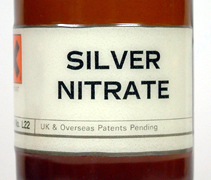
The silver halides (except silver fluoride) are insoluble in water, so we use a precipitation method to identify the halides. To test a solution for a halide it is first acidified with dilute nitric acid, then silver nitrate solution is added. Failure to add acid can confuse the test, as alkaline solutions produce a light brown precipitate of silver oxide when the silver nitrate solution is added. Some specifications add the acid after the silver nitrate solution. The silver halide remains insoluble in the added acid. |
|
This is a very popular topic for providing exam questions. You are expected to know the colours of the silver chloride, silver bromide and silver iodide precipitates. As they are rather similar in colour, we further distinguish them by their degree of solubility in ammonia solution. The silver halides are used in photography as they change colour in the light. You should see why in the following video. Watch the following video and make a table of results describing the changes you see. Check your answers with the link below.
Video - the precipitation and solubility of the silver halides
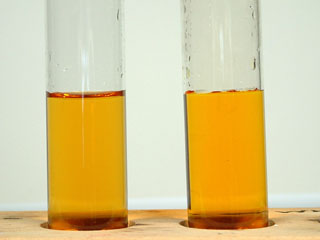
Another indication of iodide is the production of a brown (or yellow) solution of iodine on oxidation of the original iodide solution. There are many oxidizing agents which will perform this oxidation, including acidified manganate(VII) and halate(V). A similar indication for bromide is the production of yellow or orange bromine solution on oxidation.
|
|
Look at the photograph on the left. Can you tell which is the iodine solution and which is the bromine? The two solutions can easily be distinguished by adding some hydrocarbon solvent and shaking the mixture. The hydrocarbon solvent is immiscible with the aqueous solution and floats on the top. The halogens are much more soluble in the non-polar hydrocarbon solvent than they are in the water. Bromine is orange in hydrocarbon solvent and iodine is purple. Put your mouse over the picture - it should now be fairly easy to tell which is which. Chlorine appears colourless in hydrocarbon solvent. Starch solution or starch test paper can also be used to test for iodine. |
The simplest test for these two cations is to add sodium hydroxide solution to a solution of the iron salt. The insoluble hydroxides form precipitates and can be distinguished by their different colours.
|
Iron(II) hydroxide is a gelatinous (jelly-like) dark green precipitate, whereas iron(III) hydroxide is a gelatinous rusty brown precipitate. |
|
|
|
Fe2+(aq) + 2OH-(aq) ⇒ Fe(OH)2(s) green |
|
Fe3+(aq) + 3OH-(aq) ⇒ Fe(OH)3(s) orange-brown |
|
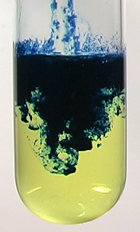
An alternative test is to use potassium hexacyanoferrate(II) solution [this tests for iron(III)] or potassium hexacyanoferrate(III) solution [this tests for iron(II)]. In both cases a deep blue precipitate forms. The precipitate is known as Prussian blue. |
|
A final, very sensitive test for iron(III) is to add potassium thiocyanate solution. A blood red colour indicates the presence of iron(III). |
|
|
|
There are two common tests for the nitrate ion. In the first iron(II) sulfate solution is added to the suspected nitrate solution. Then concentrated sulfuric acid is added carefully so that it forms a separate lower layer. If a nitrate is present a brown ring forms between the two liquids. Hence the name, the brown ring test. |
|
Alternatively, the suspect solution can be made alkaline with sodium hydroxide solution. Some Devarda's alloy powder is added and the mixture heated. A positive test produces ammonia gas. This can be tested for with damp red litmus paper - it turns blue. Aluminium foil can be used in place of Devarda's alloy. Video - Testing for nitrate ions |
|
Thermal decomposition of the solid nitrate will give off oxygen gas and possibly brown nitrogen dioxide gas. This can also be used to identify the nitrate.
|
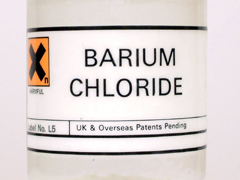
The solution is first acidified with dilute hydrochloric acid and the barium chloride solution is added. The acid reacts with a number of other ions which would interfere with the test. A white precipitate of barium sulfate indicates a sulfate. As with the halide test, some specifications add the acid after the barium chloride solution. The barium sulfate remains insoluble in the added acid. |
|
|
Ba2+(aq) + SO42-(aq) ⇒ BaSO4(s) |
Video - testing for sulfate ions
Barium sulfate is used in barium meals. The barium meal is a slurry of barium sulfate given to patients so that their intestines will become opaque to X-rays. Soluble barium compounds are poisonous, but as the barium sulfate is very insoluble it passes through the gut without harm.
Also known as sulfate(IV) ions. On adding dilute acid, sulfur dioxide gas [hazard - breathing difficulty] is released:
|
SO32-(aq) + 2H+(aq) ⇒ SO2(g) + H2O(l) |
A white precipitate of barium sulfite is produced if barium chloride solution is added to a solution of a sulfite:
|
Ba2+(aq) + SO32-(aq) ⇒ BaSO3(s) |
However, unlike barium sulfate, this precipitate dissolves on acidification.
%20hydroxide.JPG)
%20hydroxide.JPG)
+thiocyanate.JPG)