ISSR CLASSES
Checkpoint Science
iGCSE Chemistry
iGCSE Physics
iGCSE Coordinated Science
A-Level Chemistry
PRACTICALS
Practicals Home
Practicals A-Z
Study Plan for Practical Work
|
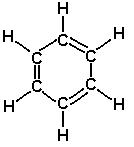
As a consequence of the effect of delocalisation, benzene is less reactive than we might at first expect. The alkenes usually react by addition with the loss of the double bond. The traditional representation of benzene shows it with three double bonds, and so we might expect to see similar reactions of benzene and the arenes as we saw with the alkenes. |
|
|
|
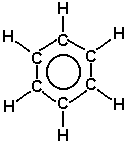
However, we know now that the real delocalised structure of benzene is much more stable than the traditional three double bond representation. If it were to react by addition we would lose this very stable electron distribution. Consequently benzene and the arenes only react by addition under severe conditions. The most usual type of reaction is substitution. As the delocalised system has a high electron density the arenes nearly always react with electrophiles. The electrophile may have a full or partial positive charge to be attracted towards the electron dense benzene ring. |
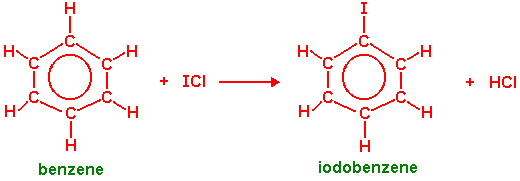
In the substitution reaction a hydrogen atom is removed from the benzene ring and replaced with another atom or group of atoms. The hydrogen atom which is lost almost always forms one of three small molecules - HBr, HCl or H2O. This allows you to work out many of the reactions of benzene. Remove a Br or Cl or OH from the attacking molecule and attach the remains to the benzene ring. For example in the reaction between benzene and iodine monochloride, ICl:
|
|
The slightly positive iodine atom becomes attached to the ring. You can work out which atom will be positive if you know the electronegativities of the atoms. The benzene ring is symmetrical, so it does not matter which carbon you attach the iodine atom to.
There is a lot to learn in this topic. Due to the lack of reactivity of the benzene ring we often need to use quite severe conditions, even for the substitution reactions. Heat is often required and a variety of catalysts are employed (these need learning!). Groups attached to the benzene ring may make it more or less reactive than benzene itself.
|
Don't forget that the benzene ring has six hydrogen atoms, so the possibility of multiple substitution is always there. This leads to the possibility of structural isomerism. For example there are 3 possible isomers of dibromobenzene. The two bromine atoms could be on adjacent carbon atoms. This is known as 1,2-dibromobenzene (old name is ortho dibromobenzene). However, 1,3- dibromobenzene (old name meta dibromobenzene) and 1,4- dibromobenzene (old name para dibromobenzene) are also possible. 1,5-dibromobenzene does not exist - it is the same as 1,3- dibromobenzene. At "A" Level it is sufficient to realize that these isomers are possible. The isomers are not formed randomly, but the isomer which forms predominately will depend on the first group which has substituted the benzene ring. This is beyond the scope of your studies, but you might like to research it in a more advanced text book. |
|
|
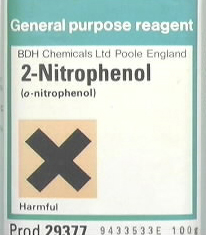
Bottle showing o for ortho |