ISSR CLASSES
Checkpoint Science
iGCSE Chemistry
iGCSE Physics
iGCSE Coordinated Science
A-Level Chemistry
PRACTICALS
Practicals Home
Practicals A-Z
Study Plan for Practical Work
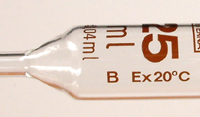
This piece of apparatus is used in volumetric work for measuring out accurate volumes of liquid. Pipettes are available in a wide range of fixed volumes. 10 cm3 and 25 cm3 are the common sizes used in schools and colleges. Graduated pipettes are also available which can be used to deliver a variety of volumes.


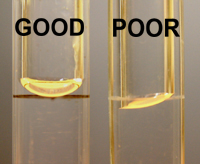
A mark is inscribed on the stem of a volumetric pipette, and as with all volumetric work, the pipette is correctly filled when the bottom of the meniscus just touches the line. The accuracy of the pipette can be either class A or class B. The pipette should be marked EX. Ex means when emptying the pipette, the tip should finally be dipped into the surface of the liquid in the flask or touched against the glass. This causes a little more liquid to be delivered. However, the last bit of liquid which remains in the pipette is meant to be there. Do not attempt to blow it out or shake it out.
|
|
There will usually be the temperature at which calibration was carried out also marked on the pipette. The volume will vary with temperature, but provided the temperature is not too far out, the error would not normally be significant for "A" level work. |
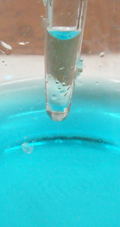
Your pipette should always be filled using a pipette filler. The pipette should be washed out before use with the solution that it is to contain. If water is used for washing, some of this remains in the pipette and takes up some of the space. Consequently, a slightly smaller volume than that stated would be measured out. To wash out the pipette, about a third fill it with the liquid that it is to contain. Tilt it to near horizontal and rotate it so that the liquid washes all the surfaces up to and slightly above the mark. Then empty the washings down the sink or into a waste beaker.
|
I find that you have much more control over emptying the pipette if you use your forefinger to control the outflow of liquid once it has been filled. To do this, when the pipette has been filled a couple of centimetres above the line, rest the tip of the pipette on the bottom of the container. This partially blocks the exit so the liquid escapes more slowly. Remove the pipette filler, and as quickly as possible, put your forefinger over the top of the pipette to prevent air entering. You will need to apply a little pressure to prevent the liquid level from falling. Get down on a level with the mark and slightly release the pressure. The liquid level should fall slowly. When the bottom of the meniscus just touches the line reapply the pressure so that the liquid level stops on the line. Transfer the pipette to the flask to be filled and remove your finger. Don't forget to touch the tip of the pipette beneath the surface of the liquid when the emptying has finished. |
|
You may use an autopipette instead of the traditional pipettes shown above.
|
|
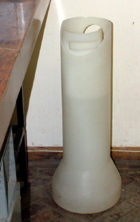
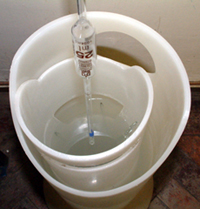
After use, rinse the pipette thoroughly with distilled water. If a pipette washer is available in the lab, place the pipette, tip facing upwards (to prevent damage to the tip), into the washer. Lower it gently most of the way into the cleaning liquid before finally letting go. |
|
Using the wrong volume pipette. Sounds silly, but it does get done! Check the pipette you are using, the volume should be clearly marked on it.
|
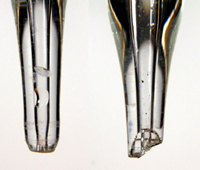
Using a damaged pipette. If the tip is broken it will not deliver the correct volume. |
|
|
|
Pipette not washed or incorrectly washed. It should be washed out with the solution which it is going to contain. A greasy pipette will not have a clear meniscus - get another one. |
Pipette jammed into pipette filler. Only apply gentle pressure.
Pipette filler damaged. The pipette tip has lifted out of the solution and liquid has shot up into the filler.
|
|
Poor judgment in filling. The bottom of the meniscus should touch the line. 1mm out is far too far out! Make your judgment with eyes on a level with the line and pipette vertical. This avoids parallax errors. |
Poor technique delivering. Don't shake out the last bit of liquid. Do allow time to drain when apparently finished (around 15 seconds). Always dip the tip under the surface of the liquid or onto the surface of the glass after the liquid has thoroughly drained.