ISSR CLASSES
Checkpoint Science
iGCSE Chemistry
iGCSE Physics
iGCSE Coordinated Science
A-Level Chemistry
PRACTICALS
Practicals Home
Practicals A-Z
Study Plan for Practical Work
|
Acids are met at a very early stage of a science career. They are usually then defined as something which turns litmus paper red or something with a pH less than 7. The key to acids is the hydrogen ion, H+. All acids dissolve in water and release hydrogen ions. It is the hydrogen ion that gives all the acidic properties. A hydrogen ion is a hydrogen atom missing its electron. In other words, it is a proton. Be careful here, the terms hydrogen ion and proton tend to be used interchangeably, and this can be confusing. |
|
|
The Brønsted-Lowry theory of acids and bases defines an acid as a proton donor and a base as a proton acceptor. |
|
|
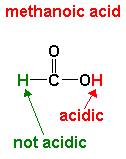
Just because a molecule contains hydrogen atoms it won't necessarily be an acid. It depends how readily these hydrogen atoms will ionize and be released from the molecule. In some cases they are just too well bound to the rest of the molecule to be acidic. We meet this most commonly with the organic acids. The carboxylic acids contain the COOH group and it is this which provides the acidic hydrogen. This group ionizes relatively easily, to find out why click here. However, these acids also have hydrogen atoms attached to the carbon skeleton. These atoms are well attached and do not confer any acidity on the molecule. The OH hydrogen in the alcohols is also well bound, and consequently the alcohols are neutral. |
It is important to realize that it is the released hydrogen ion which gives the acid its acidic properties. The hydrogen ion is released when the acid is dissolved in water, where it combines to form the hydroxonium ion, H3O+. Without the water this ionization process does not occur and so no acidic properties are seen. For example, dry hydrogen chloride gas shows no acidity, but when dissolved in water hydrochloric acid is formed. Once the hydrogen ions are released from any acid they behave in the same way. For example, releasing carbon dioxide gas from carbonates or producing hydrogen gas with many metals:
|
2H+(aq) + CO32-(aq) ⇒ CO2(g) + H2O(l) |
|
2H+(aq) + Mg(s) ⇒ H2(g) + Mg2+(aq) |
Acids react with bases to form salts. You should also understand the difference between a weak acid and a strong acid. Acid strength can be measured quantitatively using the acid dissociation constant.
You should know the names and formulae of the three common mineral acids - sulfuric acid (H2SO4), nitric acid (HNO3) and hydrochloric acid (HCl). These are used throughout your course. They are known as mineral acids because they are mineral in origin rather than organic. Ethanoic acid from vinegar is a typical organic acid.