ISSR CLASSES
Checkpoint Science
iGCSE Chemistry
iGCSE Physics
iGCSE Coordinated Science
A-Level Chemistry
PRACTICALS
Practicals Home
Practicals A-Z
Study Plan for Practical Work
|
The amines are ammonia molecules, NH3, in which one or more of the hydrogen atoms has been replaced by alkyl groups. You can find more details on the classification of amines here. Amines often have fishy smells. |
|
Amines are generally named with the -amine suffix, but the start of the name (based on the number of carbon atoms) is of the form alkyl rather than alkan. This gives a name of the type alkylamine. The prefix amino- is used when there is more than one amino group.
Examples
|
|
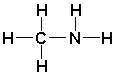
With one carbon atom and one amine group, this molecule is called methylamine. It is a primary, aliphatic amine. |
|
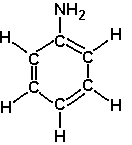
The presence of the NH2 group makes this another primary amine. However, as it is directly attached to a benzene ring this is an arylamine. Its name is phenylamine. Its trivial name is aniline, and it is an important chemical in the dye industry. |
|
|
|
This is a secondary amine with two ethyl groups attached. It is called diethylamine. |
|
This is a tertiary amine as all three hydrogen atoms on the nitrogen atom have been replaced. With two ethyl groups and a methyl group it is called diethylmethylamine. |
|
|
|
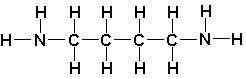
This is another primary amine. It has two amino groups and four carbon atoms. Isomers are possible, so numbers must be used, giving the name 1,4-diaminobutane. |
The key to understanding the reactions of amines is the similarity to the reactions of ammonia. The most important feature of the amine molecule is the lone pair of electrons on the nitrogen atom.
Exercise
|
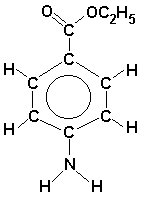
We are going to be looking at two primary amines in this experiment. Primary amines contain the -NH2 group. We shall be looking at butylamine, C4H9NH2, where the attached group is an alkyl group. This is an example of an alkylamine. We shall also be looking at an arylamine where the attached group is an aryl group. The simplest of these is phenylamine, C6H5NH2. This is used in the dye industry, and used to be called aniline. As it is toxic, we shall be using an alternative called ethyl 4-aminobenzoate. It's alternative name is benzocaine, and it is used as an anaesthetic. |
|
|
ethyl 4-aminobenzoate |
We shall also be looking at ammonia, NH3. This is because it is best to consider the amines as substituted ammonia molecules. Butylamine is an ammonia molecule in which one of the hydrogen atoms has been replaced by a butyl group. You should be able to see the similarities in their chemical reactions in the following experiments.
1 Solubility and pH
You should be able to predict the solubility of the three amines in water. Bear in mind the size of the hydrophobic hydrocarbon section of each molecule, and the fact that the NH2 groups can hydrogen bond to the water. Check your predictions in the following video.
Video - the solubility and pH of the amines
The equilibrium, which causes the amines to be alkaline, must produce the hydroxide ion, OH-(aq). Write down an equilibrium to show this occurring with ammonia, then try to write down the analogous equilibrium for butylamine. You should have estimated the pH of each of the solutions from the video. Try to explain why the pHs differ for the three compounds. You can check your answers here.
2 Formation of salts
|
|
On adding hydrochloric acid to the amines, their characteristic fishy odour disappears, although this does not come across well on video! As the ammonia and butylamine are readily soluble in water and hydrochloric acid, there is nothing additional to see when these are added to dilute hydrochloric acid. Look at the video and assess the solubility of the ethyl 4-aminobenzoate in dilute hydrochloric acid compared to that in the water shown in the last experiment. Try to explain any contrast, and suggest why the amine smell disappears on addition to dilute hydrochloric acid. |
Video - the solubility of ethyl 4-aminobenzoate in dilute hydrochloric acid
Again the amines react in an analogous way to that of ammonia with hydrochloric acid. You should be able to write down an equation for the reaction of ammonia solution with dilute hydrochloric acid. Then try to write down a similar equation for the reaction of butylamine with dilute hydrochloric acid. You can check your answers by looking at the formation of ammonium salts
3 Reaction with transition metal ions
A number of different coloured complex ions are formed in these reactions when the various amines are added to some 0.1 M copper(II) sulphate. The formation of coloured complexes on addition of copper(II) sulphate solution is often used as a test for amines. Make a note of the complex colours and write down an ionic equation for the reaction mentioned in the video. Check your answers here.
Video - the reactions of amines with copper(II) sulphate solution
4 Nucleophilic reactions of amines with acid derivatives
Review the chemistry of ethanoyl chloride, and then write equations for the first two reactions seen in the video. What explanation can you give as to the difference in reactivity of the compounds? What are the white fumes seen in the first experiment? Check your answers below.
Video - reactions with ethanoyl chloride
Results - reactions with ethanoyl chloride