ISSR CLASSES
Checkpoint Science
iGCSE Chemistry
iGCSE Physics
iGCSE Coordinated Science
A-Level Chemistry
PRACTICALS
Practicals Home
Practicals A-Z
Study Plan for Practical Work
|
There is not a huge variety of Maths in "A" level Chemistry, but what there is keeps appearing quite frequently. So it is important to be confident with these ideas. |
|
The maths ability of "A" level chemists varies very widely. You may find the following material very obvious, in which case get on with the practical! However, you may find it quite challenging. If this is the case, don't be afraid to ask for some basic maths help from your school or college.
Whenever you give a numerical answer to a calculation, think U.S.S. - Units, Signs, Significant figures. Check out these three sections - they are frequently the cause of lost credit in exams and assessments.
This is generally met when trying to work out the units of some expression. There are a number of important features to realize about powers.
When we raise a number or unit to a power, we mean that the number or unit is multiplied by itself the indicated number of times:
104 (ten to the four) = 10 × 10 × 10 × 10
m2 (metre squared) = m × m
A negative power shows that we are dividing by the expression. If you can see nothing to divide into, divide into 1:


When multiplying numbers with powers we add the powers together. The reason becomes clearer with an example:
103 = 10 × 10 × 10
102 = 10 × 10
103 × 102 = 10 × 10 × 10 × 10 × 10 = 105
When working with units it is often necessary to bring some units with powers from the bottom of a fraction to the top. When we move something from the bottom of a fraction to the top, the sign of any power changes (that is plus becomes minus and minus becomes plus).

Note first how the powers added - mol1 × mol1 became mol2, and dm-3 × dm-3 became dm-6. We don't usually bother with the power 1, so mol1 is usually just written as mol. When mol2 moved to the top it became mol-2 and when dm-6 moved to the top it became dm6.
When we are dealing with very large or very small numbers it is more convenient to express them in standard form. This uses powers of ten. It is important to understand what this means in order to avoid making mistakes here. An example should help:
3.4 × 10³
3.4 × 10³ is spoken as "three point four times ten to the three". The 103 means 10 × 10 × 10 = 1000
So, 3.4 × 103 = 3.4 × 1000 = 3400
|
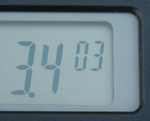
Care needs to be taken when using some older calculators as they do not always display the ten. The picture on the right shows a calculator display of 3.4 × 10³. This leads students to write this down as 3.43. Unfortunately, this is a completely different number from the one we want: 3.43 = 3.4 × 3.4 × 3.4 = 39.304 (not very close to 3400!) |
|
When dealing with small numbers we use negative indices. This is very similar to the above example, but the negative index means that we divide by the power of ten rather than multiply:
3.4 × 10-3 = 3.4 ÷ 1000 = 0.0034
Again, you need to be careful if copying these numbers from your calculator.
It is fairly easy to convert numbers into standard form. We just need to move the decimal point along to get a number in the range 1 to 9. Moving the point to the left gives a positive power, and moving it to the right gives a negative power.

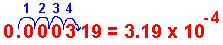
Exercise
Express each of the following numbers in standard form. Click in the ANSWER boxes to check your answers:
|
449000 |
|
|
0.0027 |
|
|
0.000000312 |
|
|
602000000000000000000000 |
|
The equations used in "A" level Chemistry are not too complicated. It is very helpful to be able to re-arrange an equation as this will save you from having to remember more than one equation for the same variables. There are various ways of re-arranging, but as always it is better if you understand why you are doing something rather than just remembering a trick.
The whole point about an equation is that the two sides are equal. This means if we carry out the same bit of maths to both sides of the equation, they will still be equal. It will still be a valid equation. This is the method we shall use to rearrange our equations. Taking the density equations as an example:
Mass = density × volume
If we want to make density the subject of the equation (that is have density = something), we have to get rid of the volume on the right hand side. We can do this by dividing by both sides by volume (the same bit of maths):

The volumes on the right hand side cancel to give the final equation:
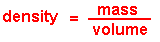
Starting from the equation we have just rearranged we shall try and get volume as the subject of the equation. The first thing to do is to get the volume of the bottom and on to the top of the expression. We can do this by multiplying both side by volume (the same bit of maths):

The volumes on the right hand side cancel to give us the equation we first started with:
density x volume = mass
We still don't have the volume on its own, but a second bit of maths should sort this out. Dividing both sides by density:

should cancel out the density on the left hand side leaving the volume on its own:
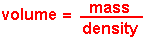
There are other ways of rearranging equations. Provided it gives you the right answers use the method you are most comfortable with.
Exercise
Rearrange the following equations to give the new subjects of the equation given in the second column. Click in the centre of the answer box to check your answer:
|
Equation |
Subject |
New equation |
|
n = c × V |
V |
|
|
|
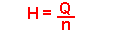
Q |
|
|
|
T |
|
The technique of dimensional analysis can help you check that your re-arranged equation is correct.
In chemistry we frequently make use of the idea of ratio. This involves scaling up or scaling down quantities in a fixed proportion. This is exactly the same principle which we use in changing the quantities of all the ingredients in a recipe. This type of calculation can be found here.
The most important use of ratio comes from the chemical equation for a reaction. The chemical equation not only tells us which chemicals are involved in a reaction, but also the ratio in which they react. We use this in titration calculations. Once we have worked out the quantity of one of the reactants we use the equation to calculate the quantity of another reactant. The ratios we meet in chemistry are usually quite simple ones:
|
NaOH(aq) + HCl(aq) ⇒ NaCl(aq) + H2O(aq) |
In the above reaction the NaOH and HCl react in a simple 1:1 ratio. Having worked out the number of moles of NaOH we know that it will always react with the same number of moles of HCl.
|
2KOH(aq) + H2SO4(aq) ⇒ K2SO4(aq) + 2H2O(aq) |
In this second reaction we see that the KOH and H2SO4 are always in a 2:1 ratio, that is there is twice as much KOH as H2SO4. Make sure you get the ratio the right way around here - the equation shows that there is more KOH. So if we know the number of moles of H2SO4 there will be twice as many moles of KOH. However, if we know the number of moles of KOH there are only half as many moles of H2SO4.
|
It is not necessary to understand the maths behind logs in order to use them in "A" level Chemistry. However, for completeness I have given a brief explanation here. Make sure you have tried out your own calculator to ensure you can carry out the log operations successfully. There are two types of log which you will meet in your course. It is important not to mix them up on your calculator. Log to base 10 (log10) is usually just referred to as log. Log to base e (loge) is called natural log and given the symbol ln. |
|
We use logs in the calculation of pH and we use natural logs in the work on activation energy. Use your calculator to calculate both types of logs, then check your results with the interactivity below:
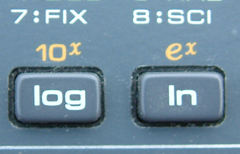
In your work with pH you may also need to reverse the log procedure. This is done on your calculator using the shift/second function key follows by the log key. You should see from the photograph of the calculator keyboard above that this is called 10x. If you want to know why check out the log theory section.
pH = - log10[H+]
So log10[H+] = - pH
Reversing the log procedure:
[H+] = 10-pH
Try using the 10x function on your calculator. You can check out your answers using the interactivity below: