ISSR CLASSES
Checkpoint Science
iGCSE Chemistry
iGCSE Physics
iGCSE Coordinated Science
A-Level Chemistry
PRACTICALS
Practicals Home
Practicals A-Z
Study Plan for Practical Work
Organic Chemistry
|
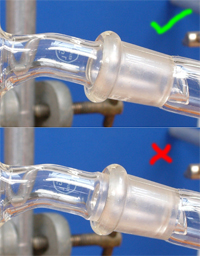
This will probably involve the use of Quickfit. This is very expensive, and breakages will count against you in assessment. Make sure that all the joints are lightly greased and the whole apparatus is securely clamped. Don't overclamp things as they will break. Hold the glassware in place and tighten the clamp until you can just not twist or slide the glassware easily in place. Students often rely on the grease to hold the glass in place. This is not a good idea, particularly if you are heating the apparatus. The grease will soften and the glass drop off! Check that all the joints are secure. Often when clamped they work loose so that there is no longer a gas-tight seal. |
|
You should understand the principles and set up of the basic techniques - reflux, distillation, recrystallization, solvent extraction and suction filtration. You may have to use a water bath for heating, an ice bath for cooling and a top pan balance for weighing.
You will often be assessed on the yield (mass) and quality of your product. To ensure good yield make sure that you do not spill any of the materials during your preparation. If a range of starting mass is given, it makes sense to use the top end of that range. Measure the mass of your product before you do any melting point determination otherwise your yield will be reduced. Your teacher will inspect your product and look for anything that shouldn't be there. If everyone else has some white crystals, and you have some yellow crystals with black lumps in them you are not going to do well! If your crystals are off-colour you could try a further recrystallization. If there are any obvious foreign bodies in your product remove them using some forceps.
Water often contaminates your organic product. If the product is a liquid the water will make it look cloudy. It should have been treated with a drying agent, like anhydrous sodium sulfate, to remove this cloudiness.
|
|
If your product is a solid, try (with the lid on!) tipping your sample bottle up and down. If the solid sticks to the sides of the tube then it is wet. In the worst cases you can actually see drops of water on the side of the tube. You need to leave the solid with good suction filtration for a few minutes to ensure some dryness. As an emergency measure you can try squashing the sample between a couple of filter papers to remove the worst of the moisture. |
Your sample bottle should always be labeled with your name, date of preparation and product name. You can add the yield and melting point range when these have been measured.