ISSR CLASSES
Checkpoint Science
iGCSE Chemistry
iGCSE Physics
iGCSE Coordinated Science
A-Level Chemistry
PRACTICALS
Practicals Home
Practicals A-Z
Study Plan for Practical Work
Theory of acid dissociation constant, Ka
This is the equilibrium constant for an acid dissociation equilibrium. It is given its own symbol, Ka:
|
HA(aq) |
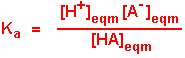
The units are always mol dm-3 - don't forget them in assessment! Strong acids have a high concentration of hydrogen ions and a low concentration of undissociated acid. This makes the Ka value large for a strong acid. Weak acids have small Ka values.
Applying this to a real example:
|
CH3COOH(aq) |
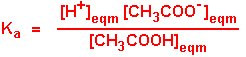
Ka (ethanoic acid) = 1.7 × 10⁻⁵ mol dm-3 at 298 K.
See a data book for further examples.
We need to use the acid dissociation constant if we wish to work out the pH of a weak acid. The following shows the derivation of the weak acid formula as it helps some people to remember it, if it worries you simply remember the final formula.
We need to make a couple of assumptions here to make the maths much easier. The first is that all the H+ ions come from the acid and not from the water. This is very nearly true. This means for an acid HA, [H+] = [A-] and so we can rewrite the Ka expression replacing [A-] with [H+]:
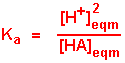
The only problem that remains is that [HA] refers to the concentration of HA at equilibrium when some of it has ionised so the concentration is less than we started with, and unknown. This is where we introduce our second assumption. If it is a weak acid then only a very small amount of it will have ionised so that we can approximate that [HA]eqm ≈ [HA]original (≈ is the symbol for approximately equal to). Introducing this approximation and cross multiplying we get:
[H+]2eqm = Ka . [HA]original
If we take the square root of both sides we get the final answer:
|
|
Example
What is the pH of 0.1M ethanoic acid?

|
= Ö (1.7 × 10-5 × 0.1) = 1.3 × 10⁻³ M |
[Don't forget to do the square root!] |
pH = - log10[H+]
pH = - log10(1.3 × 10⁻³) = 2.9
As always, check that it looks a reasonable value for the pH of a weak acid. It will depend on the concentration, but is typically pH 2.5 - 6.5. If it isn't you may have forgotten the square root.
It may be necessary to work out the Ka value for an acid. This is quite easy to do if we know the pH of a known acid concentration. We need the expression:
Remember that [H+] = [A-], so we can use the following expression:
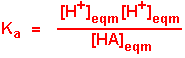
[H+]eqm can be worked out from the pH using the expression, [H+] = 10-pH (more detail here). We can work out exactly what [HA]eqm is because we know how much we started with - this is the acid concentration, [HA]original. However, some of this has now dissociated and turned into H+. What we are left with is what we started with, [HA]original, less the amount that has dissociated, [H+]eqm.
That is, [HA]eqm = [HA]original - [H+]eqm. This is easier to see in an example:
Example
The concentration of a weak acid is found to be 0.050 M by titration. What is Ka if the solution is pH 4.2?
[H+]eqm = inv log (-pH) = inv log(-4.2) = 6.3 × 10⁻⁵ M
[HA]eqm = [HA]original - [H+]eqm = 0.050 - 6.3 × 10-5 = 0.050 M
This last point gives support for our earlier estimation - so little of a weak acid ionises that it is usually a reasonable approximation to say that [HA]eqm = [HA]original.
\Ka = (6.3 × 10⁻⁵)2/0.050 = 7.9 × 10⁻⁸ mol dm-3
Try the practical exercise.
An alternative method of determining Ka involves a titration method to measure the pH at half neutralization. We might take a 25 cm3 sample of the weak acid and titrate it with sodium hydroxide solution and a phenolphthalein indicator. If it took 20.00 cm3 for neutralization, we would then take a fresh 25.0 cm3 sample of the weak acid and add 10.00 cm3 of the same sodium hydroxide solution. After thorough mixing, this means the acid is half neutralized. The pH is now measured. The pH is the pKa of the weak acid.
An adaptation of the above method involves measuring out a volume of the weak acid, typically 25 cm3. Sodium hydroxide solution of similar concentration is now added and thoroughly mixed with the acid in regular small amounts (1 cm3 is ideal). The pH is measured using a pH meter after each addition and recorded. Addition is continued until around 40 cm3. A graph of pH against volume of alkali added is now plotted. It has a characteristic shape with a large vertical jump in pH at the end-point. We read off the volume of alkali at this point, half it to find the half-neutralization point and then read the pH for this volume off the graph. This is the pKa value of the weak acid involved. You can see a typical graph here. For a faster experiment, larger volumes of alkali (say, 4.0 cm3 lots) could be used if it is not close to the end-point.
The mathematics behind these methods is fairly straightforward. At half neutralization, half of the HA has been converted into A-. This means [HA] = [A-], so [HA] and [A-] cancel in the Ka expression:
This leaves Ka = [H+]. If we take logs on both sides and change the sign, we get pKa = pH.
You may be asked for a Ka value rather than a pKa value. To convert pKa to Ka we use the 10x (inv log) key on a calculator, the relationship is Ka = 10-pKa. For example, pKa for phenol is 9.9. What is Ka? Check your answer here .
Ka values are also used in the calculation of buffer solution pH. Buffer work can also be included in practical assessments involving Ka.
 H+(aq) + A
